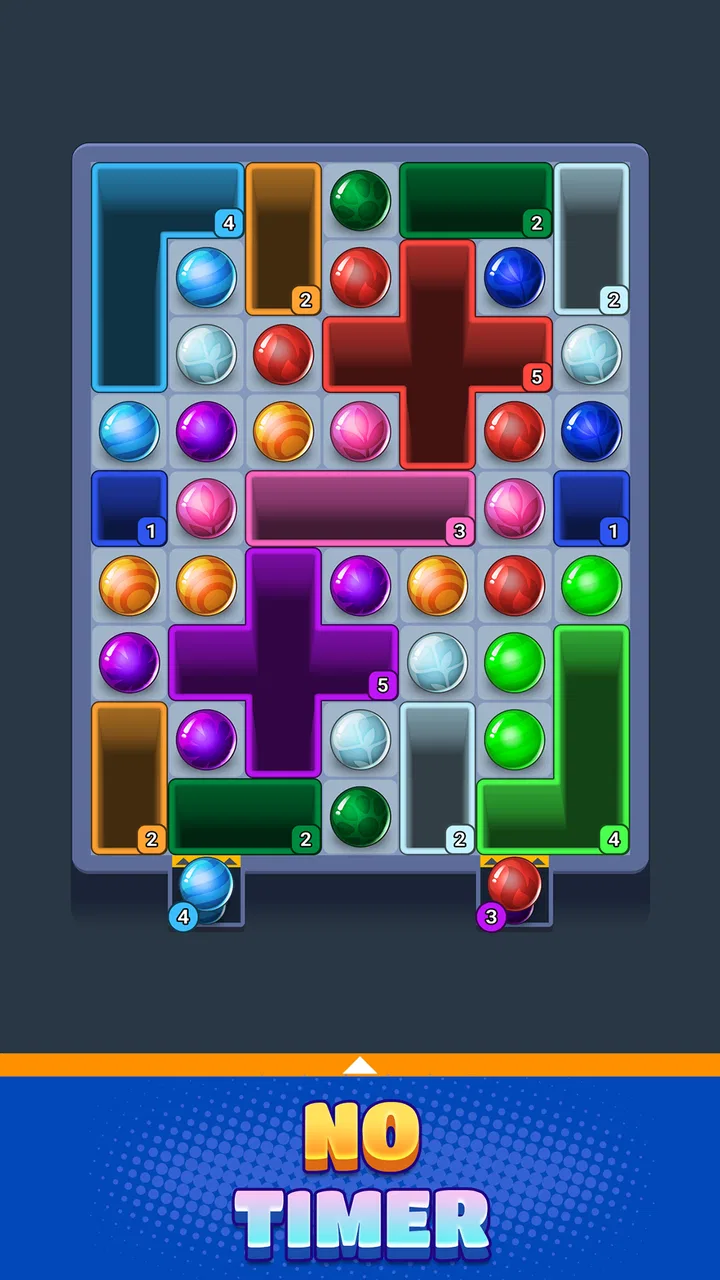
Drop Escape: Color Puzzle
- 4.6
- Rating
- 1.00M
- Installs
- Free
- Price

 Analysis by App-foxy
Drop Escape: Color Puzzle is the kind of mobile game I can open for a few quiet minutes without feeling as if I have committed to a long session. Its central idea is easy to understand: I move holes around a board, guide falling marbles, and try to complete logic puzzles. The appeal is immediate because the rules are simple, while the solutions ask me to think ahead rather than react quickly.
That balance matters. Many puzzle games either become repetitive almost immediately or add timers, lives, and pressure that turn a relaxing break into a small daily obligation. This one takes a calmer route. There is no timer pushing me to make a rushed decision, so I can study the layout, test an idea mentally, and restart my approach when it becomes clear that I have blocked myself.
I reviewed it as a puzzle game from FIOGONIA LIMITED, and my overall impression is positive but measured. The first sessions are inviting, especially if you enjoy visual logic problems. The more important question is whether it can remain useful after the novelty of moving holes and dropping marbles wears off. For me, its lasting value depends on how much I want a quiet reasoning exercise rather than a constantly changing game with a large variety of modes.
You May Also Like

 Blood Strike: 2.5 Anniversary
Blood Strike’s Loadouts Turn Every Drop Into a Tactical Gamble
A close look at Blood Strike’s custom loadouts: how fast access to signature weapons reshapes its battle royale rhythm, rewards preparation, and narrows the gap between fights.

 Pandora - Music & Podcasts
Pandora’s Music Is Easy to Start, but Harder to Recover
Pandora’s strength is its low-effort path from a seed to a station. Its weak spot is how much confidence it asks you to place in connection, setup, and quiet recovery.

 8 Ball Pool
 Is Built on Rivalries, Rematches, and Routine
A close look at the rivalries, rematches, shared routines, and unanswered safety questions that turn a quick pool match into a persistent mobile community.

 Samsung Music
’s Quiet Strength Is Playing What You Already Own
Its reach comes less from spectacle than from dependable access to a personal library. That simplicity is both the app’s strongest retention engine and its ceiling.

 AccuWeather: Weather Radar
AccuWeather Review: A Quick, Clear Forecast for Everyday Decisions
For everyday plans, the best forecast is the one you can understand quickly. AccuWeather makes rain timing, radar, and local conditions easy to act on, with a few trade-offs.

 Hill Climb Racing
Why Hill Climb Racing Still Turns Crashes Into One More Run
A tiny car, a bumpy hill and one more upgrade: Hill Climb Racing keeps resurfacing because its simple chaos makes every near-miss feel personal.
More From Our News Desk



What the first sessions feel like
The opening experience is pleasantly direct. I do not need a long explanation to understand what I am trying to accomplish, and the board itself communicates much of the challenge. The pieces are visible, the objective is tied to their movement, and the absence of a countdown gives me room to inspect the arrangement before touching anything.
That makes it especially suitable for short breaks. I can play while waiting for an appointment, during a commute when I am seated, or at the end of the day when I want something more engaging than scrolling but less demanding than a competitive game. A typical session can begin with one apparently simple board and turn into a careful sequence of moves as I realize that an early placement affects every later drop.
The most enjoyable part is the difference between a move that looks helpful and one that actually preserves future options. A hole may need to be moved away from the marble I am currently watching because another piece will need that route later. This creates a useful form of delayed thinking: I am not merely matching colors or tapping the obvious target; I am managing space and order.
Because the game is built around logic rather than speed, it also works well for players who dislike reflex-based mobile entertainment. I do not have to compete with a clock or perform repeated swipes accurately under pressure. The challenge comes from understanding the board. That gives the experience a more deliberate character than many casual puzzle alternatives.
At the same time, the simplicity can make the first-week appeal feel narrower than that of a larger puzzle collection. If you usually prefer word puzzles, number grids, physics sandboxes, or games with several distinct modes, the focused design may seem limited. Drop Escape is not trying to be a toolbox of unrelated activities. Its strength is that it stays with one idea and asks me to explore its consequences.
Why the no-timer design changes the experience
The lack of a timer is more than a comfort feature. It changes how I evaluate a failed attempt. In a timed puzzle, I may blame a mistake on pressure or simply restart because the clock is running down. Here, I can identify the actual cause: perhaps I moved a hole too early, allowed a marble to occupy an inconvenient position, or failed to reserve a route for a later step.
That makes the game a better fit for reflective play. I can pause naturally, put the phone down, and return to the same problem without feeling that I have lost a valuable attempt. For someone who wants a small mental workout during a quiet moment, this is a genuine advantage.
The trade-off is that players who enjoy urgency may find the pace too gentle. Without a countdown or performance pressure, the satisfaction comes from solving the board itself, not from beating a previous time. If your favorite puzzle games are built around speed, streaks, or rapid reactions, this slower structure may not give you enough excitement.
Small habits that improve early solving
I found it more effective to inspect the full board before moving anything. The tempting first move is not always the useful one, because a hole that looks ready for a marble may be needed as part of the final sequence. Looking for bottlenecks first is a better habit: I ask which spaces have only one practical purpose and which pieces can still be redirected.
Another useful approach is to think in stages. Instead of trying to imagine the entire solution at once, I identify the marble that must be handled first, then consider where the hole needs to be before that drop. After that, I check whether the resulting position leaves a route for the next piece. This reduces the mental load and makes the puzzles feel less like guessing.
I also recommend treating an unsuccessful sequence as information rather than immediately repeating it. If a marble lands in a dead-end position, I look at the move that made that position unavoidable. That backward check is often more helpful than staring at the final mistake. It is a small but important difference between random experimentation and actual puzzle solving.
Whether it keeps earning attention over time
The month-to-month question is more complicated. A puzzle game can be excellent in short bursts and still struggle to become a lasting habit. Drop Escape has a clear recurring use case: it is a calm, focused activity for moments when I want to think without being hurried. That is enough to make it worth keeping on my phone if I regularly enjoy this type of challenge.
Its value is strongest when I use it as a reset between demanding tasks. After reading, working, or dealing with a crowded schedule, one logic board gives my attention a narrow target. Unlike passive entertainment, it asks me to form a plan, observe consequences, and adjust. Unlike a large strategy game, it does not require remembering a complicated system before I can begin.
For a realistic everyday example, I could open it during a lunch break after finishing a meal. I might solve one board, stop before the break ends, and return to work without needing to remember a story, manage a character, or recover from a lost match. That low commitment is one of its most practical strengths.
Still, recurring value depends heavily on personal tolerance for repetition. The core interaction remains the same: move holes, manage marble drops, and reason through the layout. If the game continues to provide boards that make me reconsider the order of my actions, that foundation can stay satisfying. If the layouts begin to feel too familiar, the lack of a broader activity mix becomes more noticeable.
This is where it differs from common alternatives in the puzzle category. Match-three games often rely on quick visual decisions, chain reactions, and frequent rewards. Word games offer vocabulary variety and may fit people who enjoy language. Sudoku-style games provide a stable numerical framework. Drop Escape sits closer to spatial planning: its appeal comes from routes, positions, and consequences rather than vocabulary, arithmetic, or rapid matching.
That comparison helps clarify who should keep playing. If you want a puzzle that can occupy your hands while your attention stays light, a matching game may be easier. If you want a daily routine with a familiar grid and a strong number-based identity, Sudoku may suit you better. I would choose this game when I specifically want to manipulate a board and solve a sequence without a clock.
What makes a repeat session worthwhile
The best reason to return is not simply that another level is available. It is the feeling of refining my thinking. On a first attempt, I may focus on getting one marble into place. On a later attempt, I begin to see the board as a chain of dependencies. That shift gives the game some educational value, even though I would not describe it as a formal training tool.
It can also fit different energy levels. When I am alert, I can work through a stubborn arrangement carefully. When I am tired, I can choose a simpler board and enjoy the quiet concentration. The absence of a timer makes that flexibility possible, although the game is less suitable when I want a strong sense of progression, competition, or social interaction.
One practical tip is to avoid turning every session into a completion test. If I insist on solving several boards in one sitting, the repeated visual structure can start to feel like work. A better routine is to use it as a single-problem break. That preserves the freshness of the central mechanic and prevents a relaxing activity from becoming another task on my list.
Maintenance, friction, and the cost of keeping it installed
The maintenance burden is low in the everyday sense. There is no timer to manage, no competitive schedule to follow, and no complicated strategy layer that demands regular practice. I can leave it alone for several days and return without feeling behind. That makes it friendlier than games built around streaks or frequent events.
Its free entry also lowers the barrier to trying it. The game is listed as free, with optional in-app purchases ranging from $1.99 to $99.99 per item. That range is important to keep in mind even if I never feel a need to buy anything. For a casual puzzle that works in short sessions, I would personally approach purchases cautiously and decide whether any optional spending genuinely improves my experience rather than treating it as part of the basic cost.
The game is suitable for Everyone, which matches its nonviolent, abstract puzzle format. That makes it an easy recommendation for families looking for a calm mobile activity, although younger players may still need help with the planning involved in harder boards. The challenge is logical rather than mature or frightening, but simple controls do not automatically mean every puzzle will be easy for every age.
On the technical side, the current version is 1.0.5 and it supports devices running Android 7.0 or later. That gives the game a reasonably broad Android audience, including people who do not use a recent phone. I would still judge the experience on the actual device, because the most important practical issue in a puzzle game is whether the board is comfortable to read and manipulate on the screen.
The main maintenance concern is not storage or daily chores; it is attention. A focused puzzle game has to keep presenting situations that feel meaningfully different. If I stop seeing new relationships between the holes and marbles, I have little reason to open it instead of choosing another familiar distraction. The developer therefore has a difficult long-term task: preserve the clarity of the original idea while keeping the puzzles from blending together.
Where the experience can become tiring
The first source of fatigue is visual familiarity. When every challenge uses the same basic vocabulary, I may begin to recognize the shape of a problem before I have fully analyzed it. That can make solving faster, but it can also reduce the sense of discovery. The game works best when the arrangement forces a new order of thought rather than merely changing the positions of familiar pieces.
The second is the possibility of overthinking. Because there is no timer, I can spend too long searching for a perfect sequence when a little experimentation would reveal the answer. The relaxed design is valuable, but it also puts the responsibility for pacing on me. I need to know when to stop analyzing and test a move.
A third limitation is the lack of urgency for players who use challenge as stimulation. Some people want a puzzle to create pressure, reward speed, or provide a competitive score. This game’s calm logic may feel underpowered for them. I would not recommend it as a replacement for a fast daily challenge if that is what keeps you engaged.
There is also a subtle difference between difficulty and depth. A board can be difficult because the solution is hard to see, but that does not automatically mean it offers a deep new idea. Over time, I would judge the game by whether its challenges teach me to use the mechanic in new ways, not simply whether they take longer to solve.
My long-term verdict
After the initial novelty fades, Drop Escape: Color Puzzle earns lasting space most convincingly as a quiet, repeatable logic break. I like that it does not hurry me, that its rules are easy to grasp, and that the interesting decisions come from planning several moves ahead. The game has a clear identity instead of copying the rapid reward cycle of a match-three title.
Its audience is specific. I would recommend it to someone who enjoys spatial puzzles, wants a no-timer experience, and appreciates games that can be played in short, self-contained sessions. It is also a good choice for a player who wants something more mentally active than scrolling but less demanding than a strategy campaign.
I would suggest skipping it if you need constant novelty, multiplayer competition, rich storytelling, or rapid action. It may also disappoint players who expect every free puzzle game to offer a wide selection of modes. The focused design is both the reason to install it and the reason it may eventually leave your phone.
The game’s reception suggests that it has found a substantial audience, with an average rating of 4.6 from around 23 thousand ratings and over 1 million installs. Those figures do not replace personal taste, but they do indicate that the central concept connects with many players. I see why: the rules are approachable, the pace is forgiving, and the board encourages genuine reasoning instead of frantic tapping.
For me, the best way to keep it enjoyable is to use it intentionally. I would open it for one or two puzzles during a break, stop when concentration starts to feel forced, and return later rather than grinding through a long session. That habit protects the game from its own repetition and lets its strongest quality remain visible: it gives me a small, orderly problem when the rest of the day feels scattered.
Released on December 9, 2025, and currently marked as version 1.0.5, Drop Escape: Color Puzzle feels like a promising focused puzzle rather than an all-purpose mobile game. I would keep it installed for calm problem-solving, especially because the free starting point makes trying it easy. Its long-term success will depend on whether the puzzles continue to challenge my planning in fresh ways, but the underlying idea is strong enough to deserve a place in a puzzle fan’s rotation.
FAQs for Drop Escape: Color Puzzle
01What is Drop Escape: Color Puzzle about?
Drop Escape: Color Puzzle is a vibrant, engaging game where players navigate colorful puzzles by matching and dropping blocks to escape each level. Each puzzle requires strategic thinking and quick reflexes, making it both challenging and addictive. The game offers various levels of difficulty, ensuring it stays interesting for players of all skill levels.
02How does the gameplay work in Drop Escape: Color Puzzle?
In Drop Escape: Color Puzzle, players must match blocks of the same color to clear them from the board. The objective is to strategically drop and align these blocks to create pathways for escaping the level. As the levels progress, the configurations become more complex, requiring advanced planning and quick decision-making.
03Are there in-app purchases in Drop Escape: Color Puzzle?
Yes, Drop Escape: Color Puzzle includes in-app purchases. Players can buy hints, additional lives, or special tools to assist in solving tougher puzzles. While the game is free to download and play, these purchases can enhance the gaming experience and help players overcome challenging levels more easily.
04Is Drop Escape: Color Puzzle suitable for all ages?
Absolutely! Drop Escape: Color Puzzle is designed to be family-friendly and suitable for players of all ages. The game’s colorful graphics, intuitive controls, and progressive difficulty make it accessible and enjoyable for children and adults alike, offering a fun way to improve problem-solving skills.
05Can I play Drop Escape: Color Puzzle offline?
Yes, Drop Escape: Color Puzzle can be played offline. This feature allows players to enjoy the game without an internet connection, making it perfect for on-the-go gaming. However, certain features like in-app purchases and leaderboard updates will require an internet connection.
Pros
- Intuitive and engaging gameplay.
- Bright and colorful graphics.
- Challenging levels increase skill.
- Smooth controls enhance experience.
- Regular updates with new content.
Cons
- Ads can be intrusive at times.
- Requires internet for some features.
- Limited free hints available.
- Can be repetitive after a while.
- In-app purchases can add up.

Drop Escape: Color Puzzle
Gallery